Saturday, August 27, 2011

Divide and Conquer...

For those of you who haven't heard the news, I'm now a regular contributor for Who Forted? Magazine (those people who brought you Ghost Hunters, Inc.). What does that mean about Spooked! and its future? Well, a little bit of changes. But nothing too worrying.


For a long time now, Spooked! has become a jumbled pot of thoughts, odd new stories, supernaturally queer stuff, and whatever else I felt like writing at the moment. This blog has undergone a lot of reincarnations over the years, so it's been tough trying to toss everything I find interesting into it and not make it a chaotic mess. If I had a separate blog for all my interests, I'd probably have over a dozen blogs running at any given time. One is more than enough work, thank you.


Still, writing for WF? is a good opportunity for me to explore true history behind hauntings and those weird news stories I neglect so much these days in a different arena. That leaves the gay-themed paranormal stories and oddities for this blog, along with any other interesting paranormal bits and whatever books I happen to be working on at the moment.I think that'll help me balance things out a bit. I already have one post brewing for here, so apparently this separation of topics might be beneficial.


And I know what some of you might be thinking: He's writing for Who Forted? Great... now he's one of those people! If you mean someone who finds humor in the paranormal... well, that's been me all along. I haven't really changed. I've always done my best to strike a balance between believer and skeptic. And when people say and do stupid things, I don't think pretending it didn't happen is the best attitude. There still are some people in the paranormal field I do admire: Loyd Auerbach, Jeff Belanger, Joshua Warren, and many others. What I don't get it the superstar status we give people who haven't done much other than appeared on television.


I've been called many things over the years. Some of the best mudslinging has come when I've been accused of being a "non-believer" (though I've been attacked by skeptics for having a laugh at some of them as well). If saying many photos are dust or lens flare and not taking psychic claims at face value makes me a horrible person, then I'll gladly claim the honor. I've admitted to my mistakes (like the great "orb color theory" idea of a decade ago), but I won't back down on saying that a lot of paranormal claims have dull, simple explanations. Even so, there are things without logical explanation that do need to be looked into more. I've experienced and witnessed a few things I can't dismiss as illusion, mistaken identity, or psychological fabrication. So, I'm an optimistic skeptic? A skeptical believer? Something like that.


Regardless, I love a good ghost story. And I love digging through history to find the keys to hauntings and legends. Say what you will about the existence of ghosts; I think ghost stories are an important part of our history, culture, and society. I love doing my part to preserve these tales for future generations. How people perceive our world is just as important as how the world works. A little mystery makes even the worst times a little more bearable.

Saturday, August 20, 2011

The Hunt for Humor Never Ends...

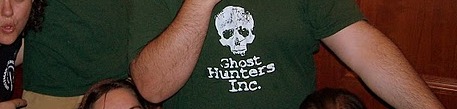
I've said it before and I'll say it again: I miss Ghost Hunters, Inc. Say what you will, it was always entertaining to see the latest adventures of the gang--with plush Scooby Doo in tow--exploring the weird, forgotten, and mythical places around Pennsylvania and New York. Back when I first started out on AOL writing up local legends, browsing their site was a favorite pasttime. Even if they didn't find anything remotely paranormal, there was plenty to laugh about. Nick, Gow, Greg, and the rest of the gang were always entertaining. I'll admit I was jealous that my own paranormal group never came close to being that fun. Maybe that's why I let it die a slow, agonizing death.


There was, of course, their movie The Graveyard Shift before things sort of fell apart. Still, some of the people involved lingered on. Jason Gowin had Extreme Paranormal for a little while. Greg, Dana, Nick, and a few more people took a dive into the skeptical humorous side (more than was normal for GHI) and created Who Forted? to keep the funniness going. As glad as I am that some of the core people are still out there doing what they do best, I can't help but get a little nostalgic. Long before bland paranormal television, we had the most entertaining bunch in Ghost Hunters, Inc. And they really didn't even find ghosts. Ever. Well... there were those few questionable times...


When I had the chance to watch and review the new(ish) documentary film done by the old gang, I had to jump at it. The Bigfoot Hunter: Still Searching takes part of an unfinished older project from 2006 (GHI vs. Bigfoot) and expands upon it. It features bigfoot hunter (and all-around paranormal enthusiast) Tim Holmes from Elmira, New York, and his gal pal Becky Sawyer on two journeys into the remote wilderness in search of Sasquatch. The one-hour film, produced by Fight or Flight Productions, is planned to be unveiled at a theater in Toronto this fall. If you have the chance to be there for it, I highly recommend it.


I really don't want to give away too much, but here's the trailer to give you a taste:


Honestly, you can't go wrong with a "former Merchant Marine" going on and on about Bigfoot, "fake footage", and a never-ending stream of weirdness and random thoughts. I'm not sure what's scarier: being out in the woods in the middle of nowhere with Tim or Nick Foust being that heavily armed (and, apparently, very excited about it). You have to love GHI for their bravery; not many people would choose to venture out far from civilization with someone quite like Holmes. The action may be minimal, but the comedy lasts throughout. The "recreation" of a bigfoot encounter is priceless... as are the short clips of Nick and Gow dressed and ready for ladies night.


Overall, it was a very well-crafted documentary. For those snobbish people who dislike anything that isn't shot in high-quality, professional grade video, you'll be disappointed by this one. But if you're not hung up on petty things like that and love watching crazy people doing and saying crazy things while turning something as mundane as wandering the woods looking for a hairy inhuman beast into an amusing look at the people and experiences in question, this is right up your alley. As a fan of documentaries, I'd be glad to add this to my DVD collection. Let's hope they decide to release it at some point.

Saturday, August 6, 2011

Pardon My l'Histoire...

Whenever history is being told, remember there is almost always a bias on behalf of the person(s) telling it. Often, parts are left out, justified by one party involved, or even told inaccurately; it takes a lot of research and work to uncover the complete history of anything. I was talking with someone yesterday about California; they made the offhand comment that the city of Hollywood doesn't have a long history. This is both true and false. As a populated city, it's just over 140 years old. When you ask any American about the history of a place, it rarely goes back any further than the earliest settlers from Europe. After the founding of the 13 original colonies, of course.

So who really counts as the first people in an area? What makes for historic events? How old is civilization in a location? Generally, these are more opinions than concrete ideas. Most of us know there were Native Americans living across the United States long before Europe even knew this land existed. But even beyond that, there are chunks of missing history left out of teachings about whole states. Even my own home state of Ohio has a far more interesting past than many of us know about.


Ohio was one of the first states beyond the original colonies to be carved out of the land back two hundred years ago. But what was it before then? You might be surprised by the answer. And had history gone very differently, we might be speaking an entirely different language.

If we go back a hundred years before the the Constitution existed, Europeans were already settling and conquering and claiming land across North America as their own. What would eventually become Ohio was part of the French colony of Louisiana (also called "New France" at certain times). Aside from the British colonies and Spanish Florida on the east (and New Mexico to the west), the rest of the land was claimed by France. This French part of Ohio history is completely ignored, but it doesn't end there. In the 18th century, Ohio was someone else's land as well.


In the decades before the Northwest Ordinance of 1787 (which almost made eastern Ohio into a state called Washington), the land owned by the French changed drastically. Spain acquired much of the western states and France split the land owned by England in half. Today, part of the section of New France stretching through the Great Lakes and St. Lawrence River all the way to the Atlantic Ocean still holds on to its heritage and early name: Quebec. Shortly before the British took possession of much of this land in 1763 through the Treaty of Paris, Ohio and parts of Pennsylvania and New York were part of Quebec. Forgotten by today's residents, a few clues remain behind. The city of Erie, Pennsylvania, still sits near Presque Isle (or presqu'île, the French word for peninsula); Ohio has towns named La Croft, Bellevue ("beautiful view"), Bellefontaine ("beautiful fountain"), Marseilles, and even Marietta (named for Marie Antoinette).


One thing is certain; the French had a better rapport with the native Indians than their British counterparts. Centers of trade and forts sprang up throughout Ohio. One French trading post was just down the road from where I live, where the Cuyahoga River meets Tinkers Creek. Another was to the south in Boston, Ohio, where early settlers found apple trees planted by the French in the 1600s. And when the British tried to take over land, the Indians tended to side with the French. After the US became independent, they sided with British Canada. This is part of the reason there was such animosity between early settlers and the natives. Indians allied themselves with the wrong side regularly. Their punishment would eventually be to live on tiny reservations, stricken with poverty and alcoholism.


While there's a lot of history we'd rather forget, there's no valid reason to deny the French past for Ohio and many other states. We seem so keen to remember the British and American portions of US history yet ignore all the rest. But this is why I love history; it's a fascinating, unending discovery full of myths and mysteries. There's always something new to learn, even about your native town.

Wednesday, August 3, 2011

Dead Women Tell No Tales... Or Do They?

It's been 13 years since one of Columbus' oldest landmarks met the wrecking ball in the name of progress. Built in 1834, the Ohio Penitentiary saw thousands of criminals pass through its doors. From Morgan's Raiders to the author O. Henry, many well-known people spent some time behind bars on Spring Street at this prison in its 150 years of operation. Today, it's the site of Nationwide Arena, a few random modern buildings, and plenty of parking spaces. But there might be a few leftover dead people lingering around.


People believed the old Ohio Penitentiary was haunted before it was demolished. Stories say that some of the 332 people who died during an arson blaze on April 21, 1930, still roamed the halls. Ghosts of many executed prisoners who breathed their final breaths inside the high stone walls were said to roam their old cell blocks and wander through the execution chamber. Though the building is gone, paranormal activity has still been reported at the site. If these prisoners really did stick around, perhaps one of them is the ghost of Ohio's first black woman to be executed. And it's quite likely she was a lesbian.


In the 1950s, sexuality was still a very taboo subject. Even newspapers, when faced with the task of telling tales of murder, often avoided the subject or (in certain cases) changing around the facts to make things sound, well, . . . less gay. That was certainly the case for Betty Butler.


By all accounts, Betty hailed from Cleveland, Ohio, where she had lived with her husband Harry, a strict Methodist, and two children. The exact reason why they couple separated is unclear, although court records indicate that Betty "associated with lesbians" in northeast Ohio. For one reason or another, Betty found herself in Cincinnati. She befriended a woman six years her senior by the name of Evelyn Clark. Some say they were lovers, while others say Betty was a woman caught up in poverty who had sex with Evelyn in exchange for money and shelter. Either way, their relationship was quite rocky. Arguments were frequent, and violence was not uncommon.


On September 6, 1952, the women were in a rowboat, joined by 42-year-old Deezie Ivory, enjoying the lake at Sharon Woods Park. A quarrel erupted between Betty and Evelyn; to escape the fight, Deezie quickly rowed to shore. There around 5:00 PM, the argument reached its peak. Betty strangled Evelyn, rendering her unconscious but still alive. In full view of the crowded park, Betty grabbed Evelyn by the ankles and held her head beneath the lake waters. "If I can't strangle her," she cried, "I'll drown her!" Leaving Evelyn partially submerged in the water, Betty nonchalantly said, "My work here is done," and walked away. She was stopped by park rangers before leaving the park; attempts to resuscitate Evelyn were unsuccessful.


Newspaper accounts varied when reporting the details. Some claimed the women argued over a man and it was a crime between "love rivals" while the Plain Dealer claimed it was a "sex revenge" murder. Jet Magazine made full mention of the "abnormal relationship", but seemed to waffle between Betty willingly becoming Evelyn's girlfriend and her being taken advantage of by a lesbian. In any case, it seemed the press was uncomfortable addressing the possibility that this was a legitimate same-sex relationship. They avoided the exact details of the crime as much as humanly possible.

Betty Butler was charged with first-degree murder and taken to jail. Her trial was swift; though Betty claimed it was self-defense "to escape [Evelyn's] perverted intentions" of keeping Betty as a "sex slave", she was found guilty and sentenced to death. She was sent to the reformatory in Marysville, Ohio, to await her execution. While in prison, Betty took up charcoal drawing and found she had a knack for art. "It's one of those things I didn't know I could do until too late," she said.

Her execution was delayed three times by appeals, but she met her fate on June 12, 1954 at the Ohio Penitentiary in Columbus. After a last meal of scrambled eggs with cheese, toast, and apricots, Betty went to the electric chair dressed in a pink and black dress with white bobby socks and white Oxford shoes. At 8:00 PM, still clutching her rosary (Betty had turned Catholic while in prison), the switch was thrown. She was pronounced dead at 8:10 PM. She was the last woman executed by the State of Ohio.

Women were housed in a building at the southeast corner of the prison, not too far from the "Death House" where the electric chair sat. Today, this spot is covered by McFerson Commons, better known as Arch Park (so named because of the stone arch found here, the only remnant left of the 1897 Union Station which once faced High Street before being demolished in 1979) at the corner of Spring Street and Street. Perhaps if you take an evening stroll in Arch Park, you can still catch a glimpse of Betty, or maybe she finally found peace and has moved on to a better place.


For more information on Betty Butler's story, read The Penalty is Death: U.S. Newspaper Coverage of Women's Executions by Marlin Shipman.

Friday, July 22, 2011

A Rose By Any Other Name...

About a week ago, author Deonna Sayed brought up an interesting and very valid question:
What makes someone a paranormal investigator? Is it active field work (with or without a team)? Watching "the shows"? Going to a few conferences? Just knowing people in "the field"? At what point does someone earn the right to claim the title?

These days, there are people out there who watch a few episodes of Ghost Hunters and BAM! They're "paranormal investigators". It's a word thrown out to describe the thrill-seeker who pays fifty bucks to tramp around a haunted prison with a hundred other people in a black logoed t-shirt as well as the die-hard individuals who've spent decades tirelessly perfecting their methods just the same. And honestly, it's a self-denoted title; there's no college accredited degree for investigating ghosts, no ectoplasmic trophy differentiating the "amateur" from the "expert" in the field (although many people use the word expert to describe themselves).


But we can't just blame it on the explosion of paranormal television. In the past decade--yes, even before cable ghost busters--I have watched people join a group, go on one investigation, quit within a week, start their own "group" a day later, and suddenly say they're "experienced professional paranormal investigators". There might be something psychological at play here: the human need for superiority, recognition, praise, and/or approval. No one likes being low man on the totem pole. We live in a world of instant gratification. Why work toward something when you can jump right to the end goal?

So, let's take a closer look at Deonna's question and break it down. Does active field work make you an investigator? Yes and no. Just like you can't learn proper brain surgery from reading a book and watching a documentary, the best real way to earn the title of investigator is to, well, investigate. A lot of important things can be learned from reading books or observing others do some form or work, but real know-how is a hands-on experience. Not everything works as well as it seems on television, and some methods used by others may be completely unreliable. Trial and error rules out the bogus from the plausible. That's something you can't simply sit back and take notes to learn. Repeated effort (and failure) is a wonderful way to learn and one way true progress is actually made.


Does watching a show make you an investigator? That's a big fat "NO". I've watched building and construction documentaries and shows, but I'm not an architect not do I pretend to be. You can learn some things for television, but it's no substitute for real life. The same applies to online websites. And for the record, no; playing Farmville doesn't make you a farmer. So how about going to a conference? Again, it's the same thing. Does going to a book conference make you a writer? Maybe if you're a hipster...


So what about knowing people in "the field"? Again, that doesn't necessarily make you an investigator. It can, however, better educate you and help you learn skills, bounce ideas off someone more knowledgeable than yourself, or even give you role models who point you in the right direction. Of course, some people like to "collect" popular people as friends as if associating yourself with a para-celebrity will suddenly give you credibility. If you want to befriend someone in the field, ask yourself why you want to know them. If it's for sharing limelight or to show off that you know the "in crowd", it's for the wrong reasons. On the other hand, if it's someone you admire or find fascinating/interesting/good-natured on a human level and wouldn't care if they were a nobody, then I say go for it.

The reality is that there are several true categories of "paranormal investigators" all lumped under the same umbrella term: the beginner curious to find explanations for the unknown, the history buff tickled at the idea of discovering 'living history', the entertainment junkie looking for a good scare or creepy old building to wander around in, the scientific-minded seeker who wants to validate or disprove the phenomena, the writer looking for an interesting story, the social person looking for a different sort of group activity, and the seasoned "professional" archiving and collecting data to try to arrive at a hypothesis. Some people are a combination of these. Others fall somewhere between. We don't have specific terms for each type of ghost hunter; to many, they're all "investigators".


Over the years, I've referred to myself as an "investigator" less and less. It's not due to early retirement or somehow being a sudden complete skeptic. (I've always held a certain level of skepticism; I find it invaluable when dealing with strange occurrences and eye-witness testimonies.) The main reason is that in recent years, I've spent more time writing about locations and researching the historical background of legends and places that I haven't spent enough time actually investigating allegedly haunted places. Do I miss it? Of course I do. And my days of looking for the unexplained are far from over. But it's the history that drives me forward. Having a psychic tell me that a 12-year-old girl died in a hotel room is all fine and dandy, but finding a documented account of that event correlating to a legend of a ghostly girl brings me a level of excitement I can't even describe. More often than not, the real history is much more interesting than the rumor.

Some of us live to find that piece of concrete evidence to prove ghosts aren't all in the mind. Others just live to be scared out of their wits. Is everyone with a flashlight, camera, and EMF meter a "paranormal investigator"? Hardly. There are the inexperienced and experienced, the green and the seasoned, the serious and the carefree. Only you know where you fall on the spectrum; whether you choose to state the truth or bend it is your own choice. But if you're true to yourself, positive things can happen. Only by knowing where you stand can you find the path to where you want to be.